Research guides
Clear, research-led explanations written for laboratory use. Every guide is framed for research purposes only, not for human consumption, therapeutic use, diagnosis or treatment.
Our compounds
Getting started
A peptide is a short chain of amino acids linked by peptide bonds, typically ranging from a couple of residues up to around 50. Proteins are built the same way but fold into larger, more complex structures. That size difference is why peptides are widely used in laboratory research: they are simple enough to synthesise consistently and study in isolation, while still being complex enough to interact with specific receptors and signalling pathways.
In a research setting, peptides are supplied either as a lyophilised (freeze-dried) powder in a sealed vial or pre-loaded into a calibrated pen device for consistent, repeatable measurement on the bench. Both formats are supplied strictly for laboratory research use.
Every batch we supply is independently verified before sale, and a certificate of analysis is available on request for any listed batch. See our guide on reading a certificate of analysis for what to check.
Research peptides and related compounds sold for laboratory use occupy a different regulatory category to licensed medicines. They are not approved, tested or labelled for human or veterinary consumption, and nothing on this site is a medical product or a claim of therapeutic effect.
We supply strictly to purchasers ordering for laboratory research purposes. By placing an order you confirm you are 18 or over and that you are responsible for using, storing and handling the product in accordance with the laws that apply to you and appropriate laboratory practice.
This guide is general information, not legal advice. If you are unsure how research-use compounds are regulated in your specific context, we'd recommend checking current guidance yourself before ordering. Full terms are on our compliance page.
Every research compound on our menu is supplied as a lyophilised vial. The vial is the product: it holds the batch-verified compound, freeze-dried for stability, ready to reconstitute to your own protocol.
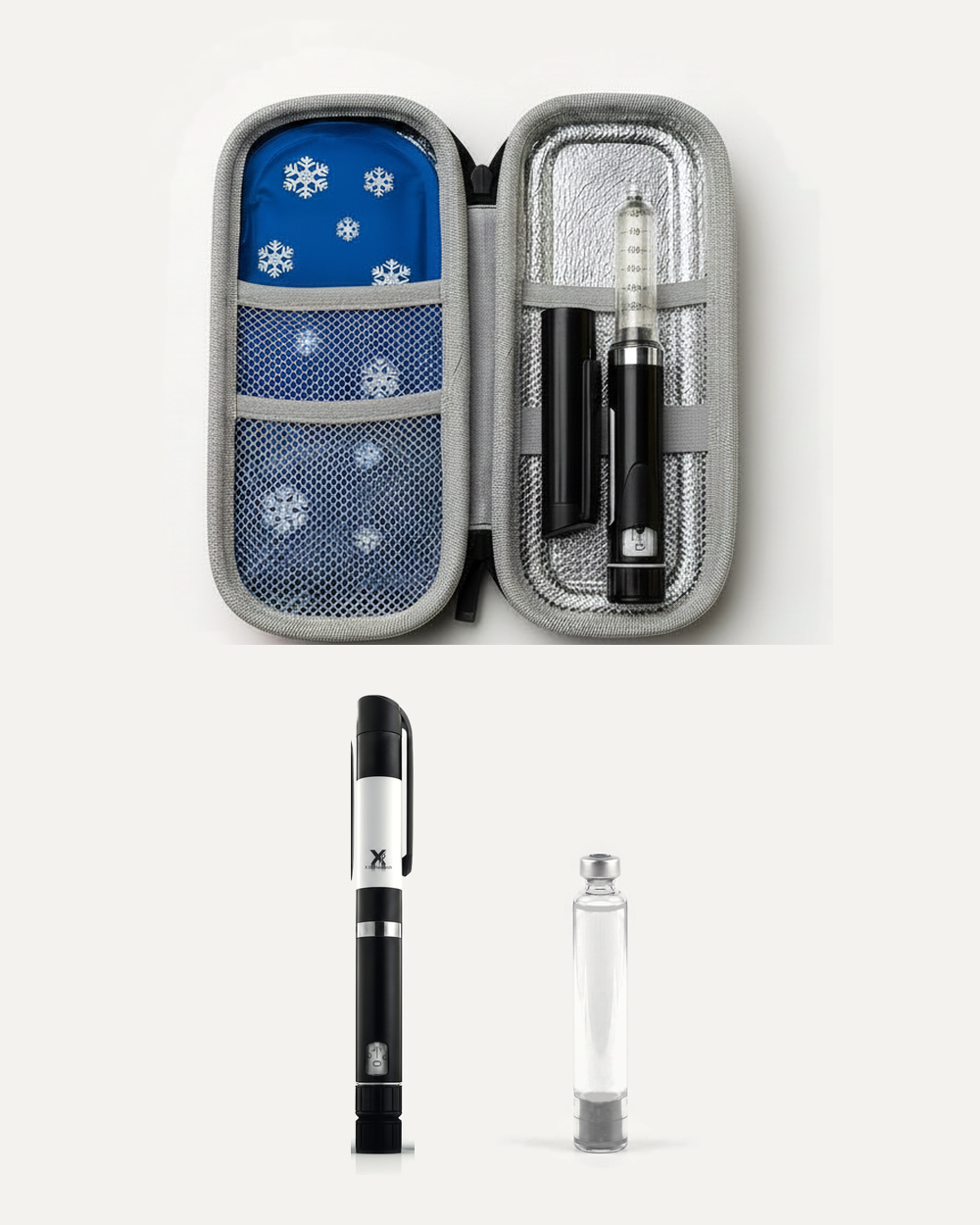
The reusable injector pen is sold separately and ships empty, with no research compound inside. It is a click-calibrated device you pair with a reconstituted vial when you want consistent, repeatable measurement across your work.
In other words, you always order the vial for the compound itself. The pen is optional hardware: order one if you don't already run your own dosing device, and reuse it across future vials.
You can add a vial and a pen to the same order, or order the vial on its own.
Handling & documentation
Our reusable pens use a click-ratchet barrel: each click advances the internal plunger by a fixed, calibrated increment, displacing a known volume of liquid from the glass cartridge once you've loaded a reconstituted vial. That's what makes a click count a repeatable reference point rather than an estimate.
Under the cap sits a sealed glass cartridge and a chrome collar. The cap lifts off to expose the cartridge and threaded tip; nothing about the mechanism is decorative, every part is there to keep measurement consistent across the life of the device.
Store the pen as you would any glass-cartridge lab device: upright, away from direct light and heat, and recap fully after use.
Lyophilised (freeze-dried) peptides are considerably more stable than reconstituted solution, which is why vials are shipped as powder rather than pre-mixed. Unopened and stored correctly, a lyophilised vial holds its integrity far longer than the same compound in solution.
As a general rule for laboratory peptide handling: keep vials and pens refrigerated once received, protect them from direct light, and avoid repeated temperature cycling. Once a vial is reconstituted for research use, treat it as a time-limited, single-protocol quantity rather than long-term storage.
This is general handling guidance, not instructions specific to any one compound's stability data. If your protocol requires documented stability parameters, request the certificate of analysis for your batch.
A Certificate of Analysis (COA) is a document from an independent lab confirming what's actually in a given batch — typically identity confirmation and purity, tested against the specific batch you're holding rather than a generic product spec.
Every batch we list is independently verified before sale. We don't publish every COA on the product page by default, but one is available on request for any listed batch — message us on Telegram or WhatsApp with your order reference and we'll send it across.
When you receive a COA, check that the batch number on the document matches the batch number on your product label. A COA for the wrong batch tells you nothing about what's in front of you.